

105. Fiestaware
Harmlessly radioactive

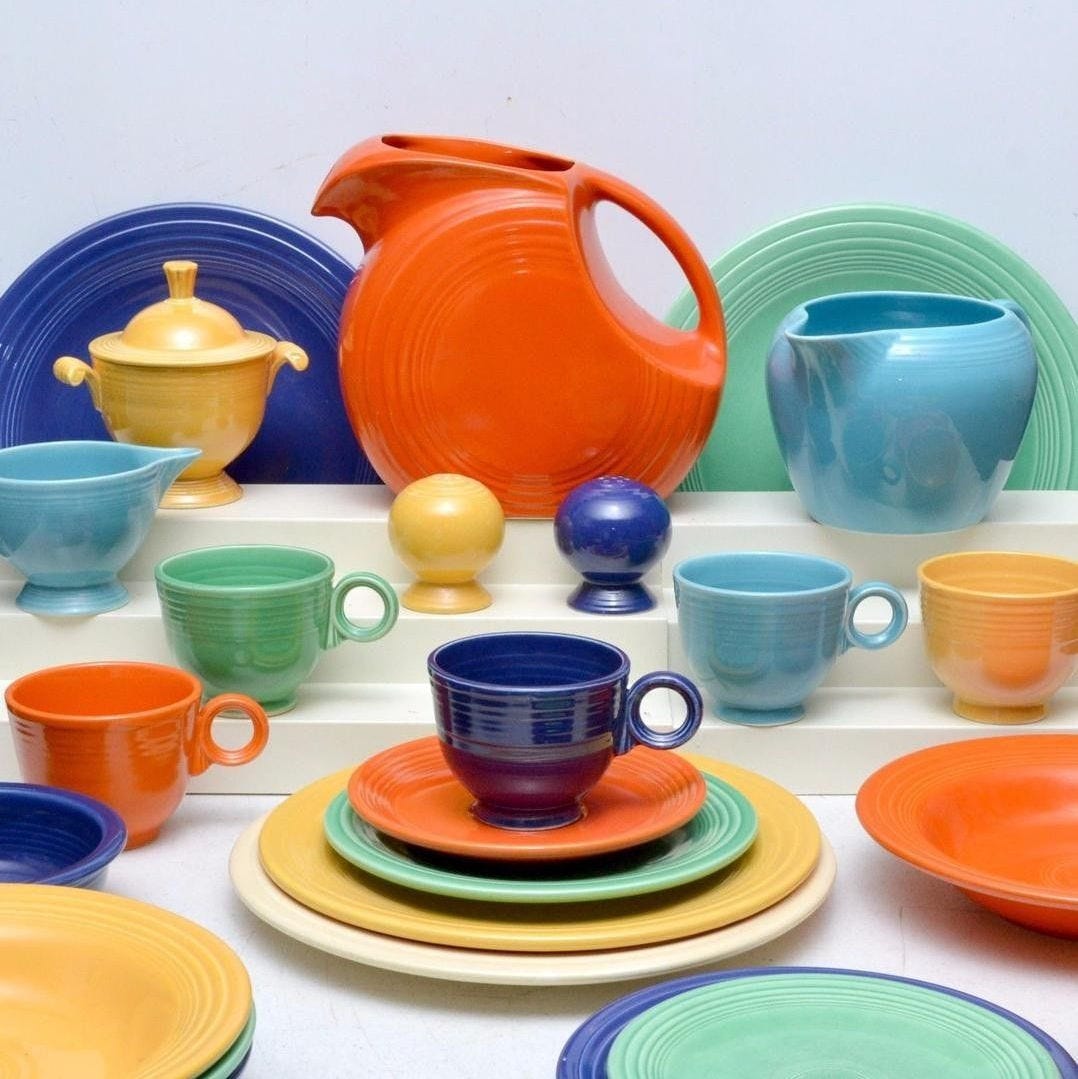
In 1936, a full decade after Art Deco began transforming consumer design, the American table remained stuck with fusty Victorian bone china with floral decals. It was the depths of the Great Depression. People had no money and badly needed a lift.
In West Virginia, the Homer Laughlin China Company recognized that the old ways weren’t working. They gambled on Albert Bleininger, head of ceramics at the National Bureau of Standards, luring him with a handsome salary. Bleininger modernized the company’s manufacturing processes, reducing costs, while designer Frederick Rhead developed a radical new design that upended the convention of matched china sets. American tables would never be the same.
Fiesta was designed with the Depression consumer in mind. It was cheerful and affordable, designed with concentric circles that looked both hand-thrown and refreshingly modern. Most of all, it came in five bright, complementary colors, which customers were encouraged to mix and match—meaning they could purchase a set piece-by-piece, buying only the items they wanted.
Those original colors were achieved with uranium oxide—up to 14% by weight in the red glaze, which the company described as “harmlessly radioactive.” The EPA now recommends against eating off the originals.
After a thirteen-year hiatus in the 1970s and 1980s, the brand returned, cannily introducing new colors, retiring old ones, and cultivating a devoted collecting community, with rare vintage pieces selling for thousands at auction. Fiesta remains the quintessentially American china—sturdy, cheerful, wholly disinterested in tradition beyond, now, its own.
Links:
Fiesta Plate - American History Museum, Smithsonian Institution
A Different Shade of Green – Kelly Alexander, New York Times, December 1, 2002
Too many emails? Instructions for receiving a weekly summary can be found here.
This post is part of The American 250, a series featuring 250 words on 250 objects made by Americans, located in America, in honor of the country’s 250th anniversary. Through December 31, 2026.
I’m looking for ideas for this series — have something you’d like me to consider for inclusion? Please feel free to leave a comment!
And don’t you think Harmlessly Radioactive would make a great band name?
Harmlessly Radioactive! I did not know this. Harding Black used uranium in some of his glazes with beautiful results, but NOT harmless. Thanks Rainey! Keep up the good work!