

97. Ben Franklin’s Tooth
He would appreciate the joke.

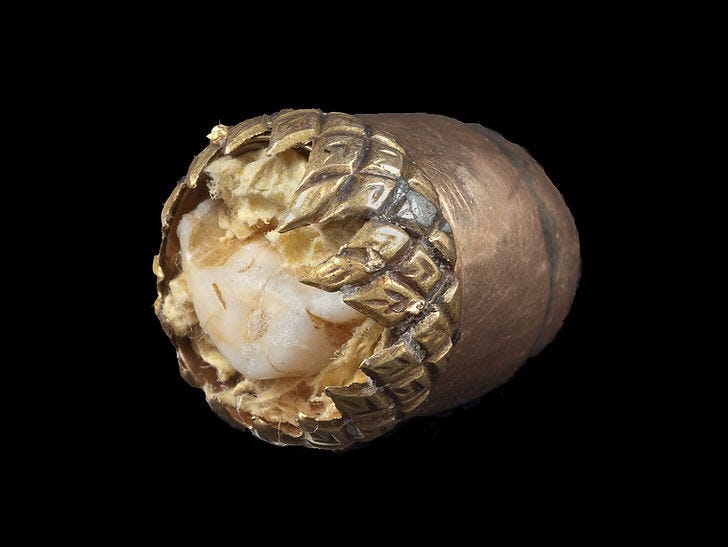
What does it mean to hang onto a piece of a person’s body after they’re gone? If I had Benjamin Franklin’s tooth, I would keep it, make a pretty case for it—maybe in the shape of an acorn, the seed of a great man. I would cherish such an object, or at least keep it as a curiosity. Wouldn’t you?
But—why? Why do we keep sacred relics? That’s what this is, no different from any saint’s kneecap in a church in Europe. This is a sacred relic, and how ironic—the brilliant, eccentric Enlightenment thinker who wasn’t religious, the Freemason—here he is, or here’s his molar anyway. Even if we don’t genuflect in front of it, there’s nonetheless a sense of reverent, albeit morbid curiosity.
Franklin, with his sly wit, would doubtless be amused that we’re here, considering his tooth—his tooth!—in the collection of the American Philosophical Society, which he founded. He would appreciate the joke.
And yet there’s another Franklin: the irreligious man who nevertheless prayed daily to “the Infinite.” There’s the man who would see the magic in this, from his mouth to our eyes across the centuries. Franklin carried this tooth throughout his long and eventful life, through dinners, debates, ocean crossings, experiments, flirtations, and treaties. Conjuring the country from thin air. This bit of him was right there, so close to his thoughts, through all of it. And so we keep it as a souvenir. Which seems right.
Links:
See footnote below about Franklin’s writing on faith.
Too many emails? Instructions for receiving a weekly summary can be found here.
This post is part of The American 250, a series featuring 250 words on 250 objects made by Americans, located in America, in honor of the country’s 250th anniversary. Through December 31, 2026.
I’m looking for ideas for this series — have something you’d like me to consider for inclusion? Please feel free to leave a comment!
Note:
Franklin’s 1728 “Articles of Belief and Acts of Religion,” an early writing, sets out an Enlightenment liturgy that tacitly does not acknowledge Christianity. As of this writing (May 21, 2026), the Library of Congress website includes an absurdly brief, partial transcription from the manuscript, just the first line of it: “I Believe there is one Supreme most perfect Being, Author and Father of the Gods themselves.” The public should be trusted to handle the full text, which is not available on the LOC’s website. It is, however, available elsewhere, and it’s a full-throated, beautiful statement of faith, albeit a statement of doubt about some tenets of organized religion:
“In as much as by Reason of our Ignorance We cannot be Certain that many Things Which we often hear mentioned in the Petitions of Men to the Deity, would prove REAL GOODS if they were in our Possession, and as I have Reason to hope and believe that the Goodness of my Heavenly Father will not withold from me a suitable Share of Temporal Blessings, if by a VIRTUOUS and HOLY Life I merit his Favour and Kindness.”
Thank you for this. I've long admired Franklin since reading the orange biography in 5th grade. And now I have his Articles of Belief, thanks to you. And I so enjoyed teaching about him through his system of perfection and biographical writings....
"Conjuring the country from thin air". So elegantly put and such a reward for the Impatient Readers that too many of us are these days.