

89. Airmail Arrows
The Stonehenge of a young country

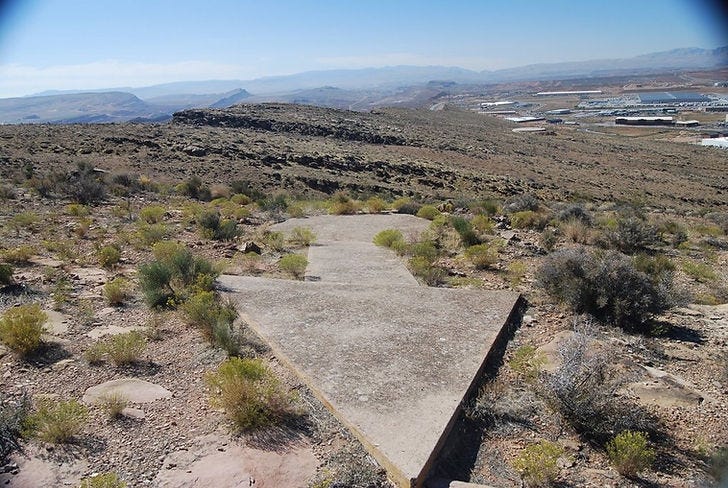
The first radio transmission was in 1901, and the first powered flight in 1903. But it would be another 25 years before radio navigation for airplanes became viable or widespread. During that interim, pilots navigated visually using roads, mountains, and rivers during the day. Night flying was dangerous, but when the US Postal Service established air mail, it needed pilots to fly at night. A simple, analog solution emerged: the USPS built beacon towers every 10 miles, with huge concrete arrows painted yellow on the ground that pointed towards the next beacon. Alone in open cockpits, pilots would hop from pool of light to pool of light through the darkness, following the arrows across deserts and plains.
By 1933, some 1,500 beacons marked 18,000 miles of routes across the nation. But this massive national system was already obsolete after only nine years. It was abandoned in place; the towers were eventually torn down for World War II scrap metal. Many of the concrete arrows were also demolished, but hundreds remain scattered across the country. Enthusiasts have mapped them on websites from the 2010s, which themselves feel antiquated.
Those websites’ images of cracked and weathered concrete arrows in uninhabited landscapes are haunting: 70-foot markers pointing to unknown horizons for reasons we no longer remember. Gigantic signs designed to be seen from above, from a perspective we’d only recently acquired, they’re the Stonehenge of a young country—mysterious monuments forgotten in a single lifetime.
Links:
Too many emails? Instructions for receiving a weekly summary can be found here.
This post is part of The American 250, a series featuring 250 words on 250 objects made by Americans, located in America, in honor of the country’s 250th anniversary. Through December 31, 2026.
I’m looking for ideas for this series — have something you’d like me to consider for inclusion? Please feel free to leave a comment!
Fascinating!!!
Jiminy...I did not know about this! Just a wonderful addition to this great project. Thank you. Of course, I've heard of love letters stuck in tumbling weeds and strips of cloth tied to trees, messages on beaches, and I'm so glad to know about this! Thank you!