

65. Playboy
"Reading it for the articles"

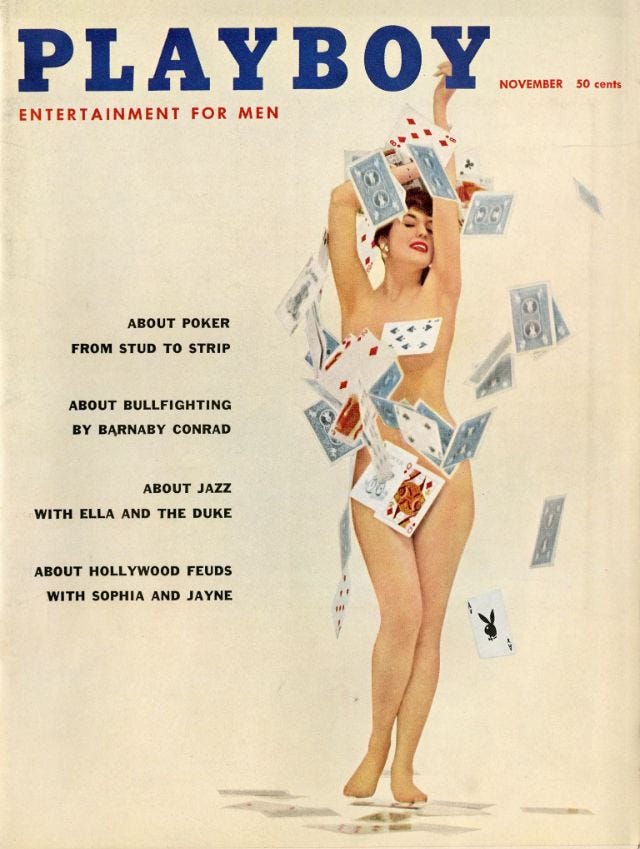
Well before the Summer of Love, Playboy was already reinventing American sexuality. As women began resisting the postwar stereotype of the happy housewife, Playboy upended the male counterpoint to that: the breadwinner and head of the household. The Playboy male was an urban consumer, hip and sophisticated, with jazz records, abstract art, and a fully stocked cocktail bar. But in breaking apart the 1950s nuclear-family fantasy, Playboy created a new oppressive ideal to conform to: an unattainably hip bachelor lifestyle with easy access to sweet, wholesome girls who wanted sex.
“Reading it for the articles” has been a punch line for fifty years, but it’s hard to argue with what is the greatest unintended archive of postwar American intellectual life. Hugh Hefner paid his writers triple what competitors offered, and the talent was staggering. Ray Bradbury serialized Fahrenheit 451 in early issues; James Baldwin published civil rights essays; contributors included Margaret Atwood, Roald Dahl, Joyce Carol Oates, and García Márquez. The magazine that teenagers hid under mattresses also ran Malcolm X’s first in-depth interview.
And of course, there was the flesh. The magazine’s tastefully lit centerfolds suggested that women—even the nice ones, even the single ones—enjoyed sex.1 It was a subversive claim in the postwar years. But in 1963, Gloria Steinem went undercover at the New York Playboy Club, emerging with an exposé documenting grueling physical demands and poverty wages. The casual harassment baked into the fantasy was a contradiction the magazine would spend decades failing to resolve.
Special thanks to Tom McDonald for suggesting Playboy.
Links:
Rebuttal to ‘A Bunny’s Tale’: I Taught Gloria Steinem How to Be a Playboy Bunny – Chialing Young King, Daily Beast, August 25, 2023
Malcolm X: the Playboy Interview - Alex Haley, Playboy, May 1963
Hugh Hefner: Civil Rights Activist? - Janice C. Simpson, The Root, July 30, 2010
Too many emails? Instructions for receiving a weekly summary can be found here.
This post is part of The American 250, a series featuring 250 words on 250 objects made by Americans, located in America, in honor of the country’s 250th anniversary. Through December 31, 2026.
I’m looking for ideas for this series — have something you’d like me to consider for inclusion? Please feel free to leave a comment!
Carrie Pitzulo, Bachelors and Bunnies: The Sexual Politics of Playboy, The University of Chicago Press, 2011, p. 6.
For men of my college years, Playboy was a paradox--Innocence built on blindness. A strange cultural hybrid--a gateway to literature, satire, political commentary, and ideas wrapped in a commercialized fantasy of women that now reads as naïve at best and harmful at worst.
That combination—wisdom delivered through a vessel that was itself ethically compromised—isn’t an anomaly. It’s a pattern that shows up across culture. It’s the same paradox that lets a church hymn move someone even if the institution caused harm, a beloved teacher shape a life even if he held blind spots, a civil rights leader who inspire a nation even though he abused women, a nation inspire devotion even as it fails its ideals.
Institutions fail. People fail. Culture fails. Yet truth still leaks through the cracks. We inherit wisdom through imperfect channels because all channels are imperfect.
💖🔥🔥🔥