

56. Stop Sign
A stage for folk performance

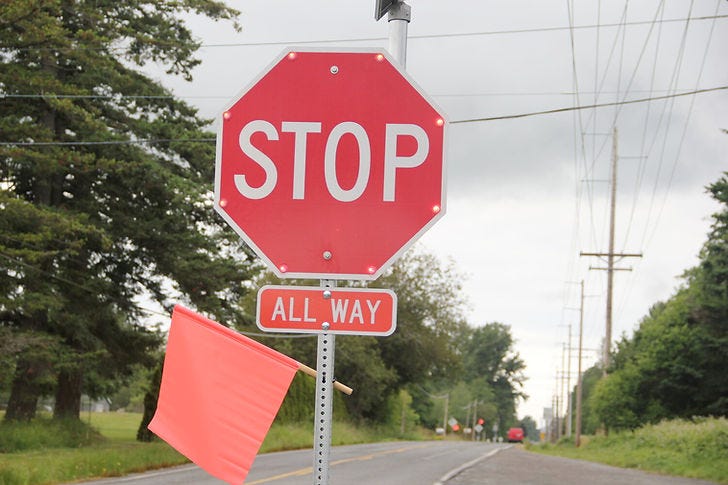
It may be the most recognizable command object in American life. In a country whose very foundation is the suspicion of authority, we all—mostly—obey that metal octagon.
The first one appeared around 1914 in Detroit, a hand-lettered sign placed at a busy intersection. Motorists obeyed! The idea spread quickly, and by 1922 the octagonal shape became the standard, a device built for strangers who must cooperate without speaking.
And yet the stop sign isn’t all that successful. Over the past 40 years, American drivers have been recorded obeying stop signs less often. Why? It’s tempting to assume we’re becoming ruder, that stop-sign scofflawism is a symptom of declining civility.
But perhaps Americans are well-meaning drivers navigating an increasingly flawed signage system. What’s meant to make us safer paradoxically makes us less so—we’re less attentive to the road because we’re following a forest of signs among trees and parked cars. If there’s a problem, we think: add more. Add lights. Add another sign that says ALL WAY. Add a flag! But improving signage to fix driver behavior is like fighting illiteracy with better fonts.
No, despite the stop sign’s charm as a stage for folk performance—people steal it, shoot at it, hijack its command into jokes and political messages—our red-blooded American stop signs don’t work as well as roundabouts. At roundabouts, crashes drop 40% and fatal crashes drop 90%. Rather than telling us what to do and hoping we comply, the roundabout ensures we do it.
Links:
“Stop! Is it possible to design a better stop sign?” – Tom Vanderbilt, Slate, May 25, 2010
“Distracting Miss Daisy: Why stop signs and speed limits endanger Americans” – John Staddon, The Atlantic, July/August 2008
Too many emails? Instructions for receiving a weekly summary can be found here.
This post is part of The American 250, a series featuring 250 words on 250 objects made by Americans, located in America, in honor of the country’s 250th anniversary. Through December 31, 2026.
I’m looking for ideas for this series — have something you’d like me to consider for inclusion? Please feel free to leave a comment!
What a strange and surreal image very odd its power
This was verrry interesting, especially since I live in the country and avoid at all cost big city travel, congestive interstates, and lots of signage. Alas, I'm only partially successful, but when I ministered in Las Vegas, NM, roundabouts were constructed at two places, as I remember, and within six years, one of the areas returned to 4-way stop. Hmmmm....I didn't mind roundabouts in England, but there's one in Washington, D.C. that scared to me death...and I was walking!!Thank you!