

31. Ouija Board
Cue the bonfires.

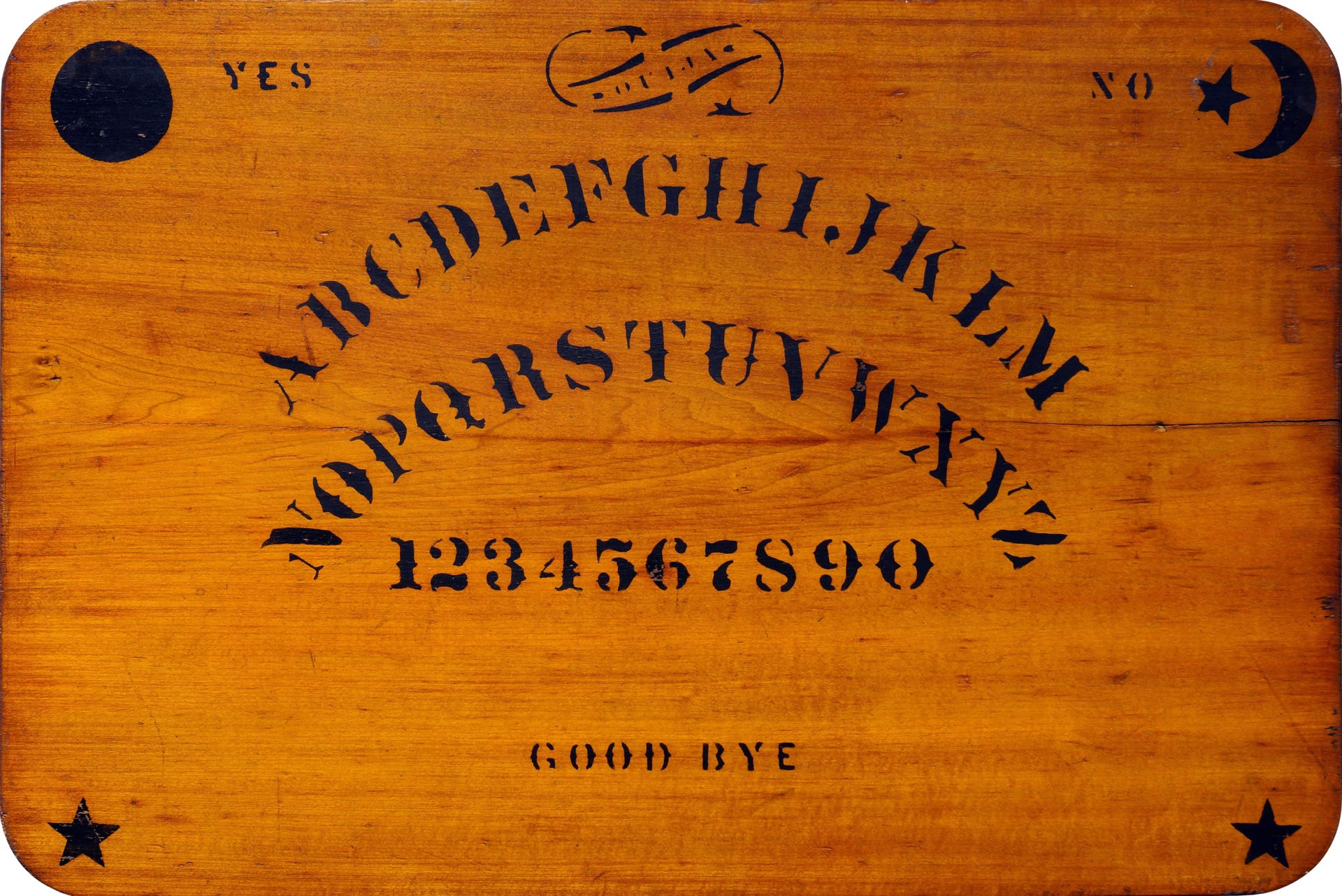
In the wake of the Civil War, a tsunami of grief that lasted for decades engulfed the country. With roughly 750,000 dead, nearly every family had lost someone. Out of that mass bereavement rose the Spiritualist movement—séances, mediums, and devices that promised contact with departed loved ones. “Talking boards” were in use by 1886; in 1891 a patent was granted for the Ouija after it allegedly spelled out the patent officer’s name. By the next year, some 2,000 boards were selling each week. The board remained a mainstream family game through the 20th century, briefly outselling Monopoly in the 1960s.
The Ouija occupied an ambiguous cultural space—part kooky novelty, part metaphysical tool—until The Exorcist decisively recast it in the popular imagination as a Satanic gateway. Cue the bonfires.
That the board is demonic seems as silly as the notion that a mass-produced plastic toy can speak to the dead. Still—as a society, we’ve lost the certainty of old-time, literal visions of the afterlife. Those stories don’t work for many of us anymore, except as metaphor, and we’re fumbling toward a belief suited to the times. Barren materialist philosophy that reduces us to chemistry leaves our yearning unfulfilled, scoffs at the word “soul.” We wonder: if our bodies are configurations of energy when we’re alive, what becomes of that energy when we die? And we secretly, tenderly hope that there is more in heaven and earth than is dreamt of, either in our philosophies or our parlor games.
Special thanks to Julie Webb for the idea of the Ouija board.
Links:
From my archive: “What Happens When We Die,” September 28, 2025
“The Ouija board’s mysterious origins: war, spirits, and a strange death,” by Baynard Woods, The Guardian, October 20, 2016
“The Ouija Board Can’t Connect Us to Paranormal Forces—but It Can Tell Us a Lot About Psychology, Grief and Uncertainty,” by Linda Rodriguez McRobbie/updated by Ellen Wexler, Smithsonian Magazine, October 2013/October 2024.
Gallery of historic images of talking boards - Talking Board Historical Society
The Ouija Board - Strong National Museum of Play, Rochester, NY
Too many emails? Instructions for receiving a weekly summary can be found here.
This post is part of The American 250, a series featuring 250 words on 250 objects made by Americans, located in America, in honor of the country’s 250th anniversary. Through December 31, 2026.
I’m looking for ideas for this series — have something you’d like me to consider for inclusion? Please feel free to leave a comment!
Ah....yes, the 60's. I remember well: mother's admonitions when I went to slumber parties, and the movies, and the "specials" on TV. So much so that I've never seen The Exorcist; I probably should not admit that. The history is valuable and am glad I know it now as a product of the human condition: as we seek connection with those we have loved. Thank you
Once again, so informative, nostalgic, and thought-provoking. A deeper level of existence that seems to make itself known now and then, particularly in stillness -- approaching such intimations with humility, curiosity, and quiet reverence makes sense to me. And just knowing that a childhood novelty or game had its roots in mass grief and longing for loved ones is strangely moving.