

137. Dime
Liberty over tyranny

What is a shilling, anyway? The old British monetary system was a mess: 12 pence to a shilling, 20 shillings to a pound, all awkward fractions and mental arithmetic. The Continental Congress wanted to throw that system out the window, replace it with a rational, base-10 currency, teachable to a child in an afternoon. In his 1784 Notes on the Establishment of a Money Unit, Thomas Jefferson wrote:
The most easy ratio of multiplication and division is that by ten, Everyone knows the facility of decimal arithmetic…. The bulk of mankind are schoolboys through life.
And so we have the little dime, ten times a penny, one-tenth a dollar—though it has always read ONE DIME on the coin, never “Ten Cents,” because everyone knows what it’s worth.
It is certainly our most charming and diminutive coin—the “Mercury” dime (1916-1945) is often said to be our prettiest. But the dime acquired, and lost, a second meaning in the 20th century: until the eradication of polio, it was associated with the March of Dimes, championed by FDR, the stricken president whose face would adorn it shortly after his death. Millions of Americans mailed dimes to the White House to help defeat polio.
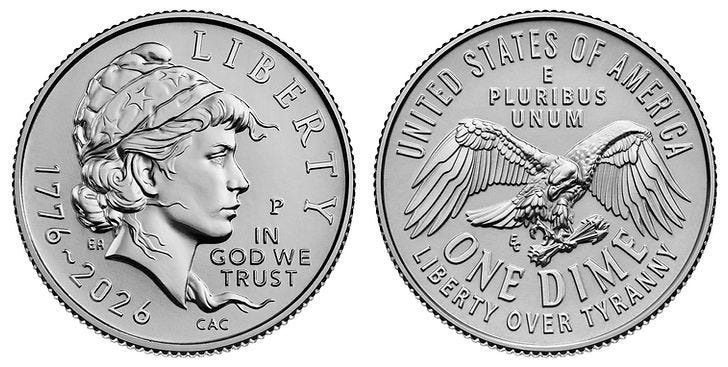
For the country’s 250th anniversary in 2026, the US Mint released the “Emerging Liberty” dime, showing a tousled, wind-blown but determined profile of Lady Liberty, with an eagle on the reverse above the words LIBERTY OVER TYRANNY.
That phrase has never appeared on a US coin before.
Links:
Too many emails? Instructions for receiving a weekly summary can be found here.
This post is part of The American 250, a series featuring 250 words on 250 objects made by Americans, located in America, in honor of the country’s 250th anniversary. Through December 31, 2026.
I’m looking for ideas for this series — have something you’d like me to consider for inclusion? Please feel free to leave a comment!
Thank you! Very interesting, and I enjoyed the rationale of Jefferson!