

124. Fraktur
They seemed un-American.

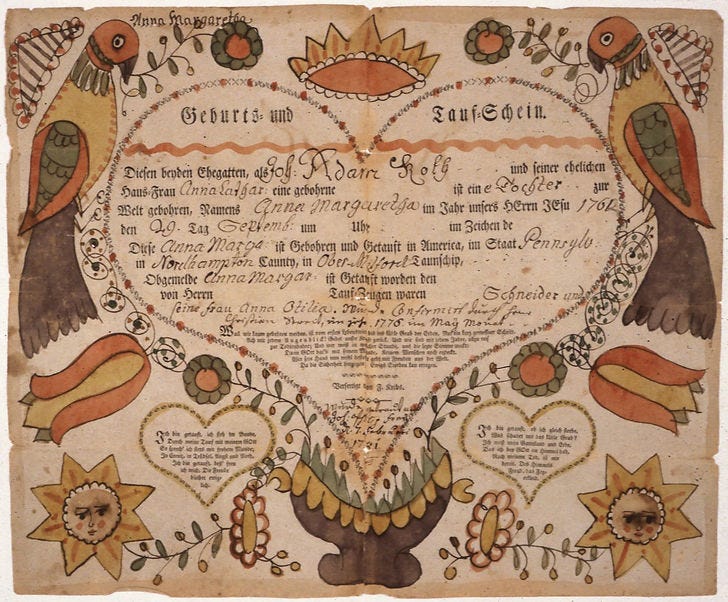
Imagine hanging your great-great-grandmother’s hand-lettered birth certificate on the wall, and nobody in your family can read it. We forget this, but the country is almost as much German as it is English. The two World Wars killed off whatever remained of that identity; suddenly it was socially unacceptable to speak German, or to remember that your family ever had. But there are nearly as many people here with German ancestry as there are with English.
Immigrants came from present-day Germany—at that time, the crumbling remnants of the Holy Roman Empire—in a steady wave starting in the 1700s. In places like southwest Pennsylvania, home of the Pennsylvania Dutch (“Deutsch”), they existed in a kind of bubble, preserving their language and culture, their way of marking the passages of life.
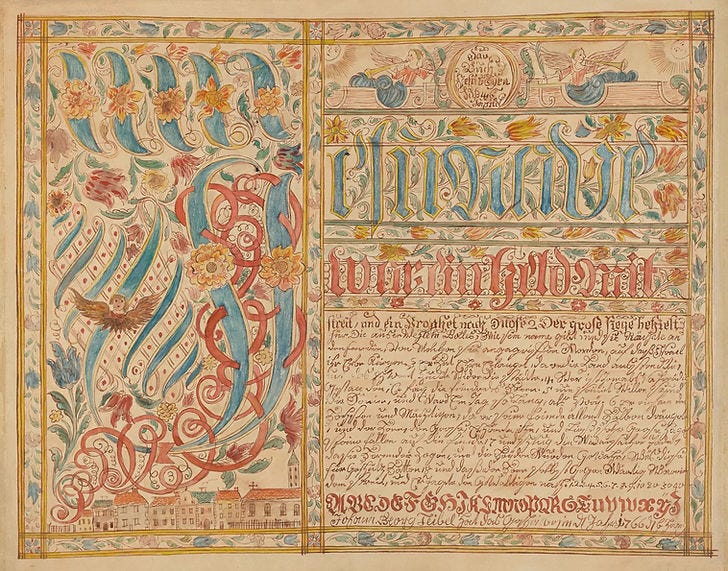
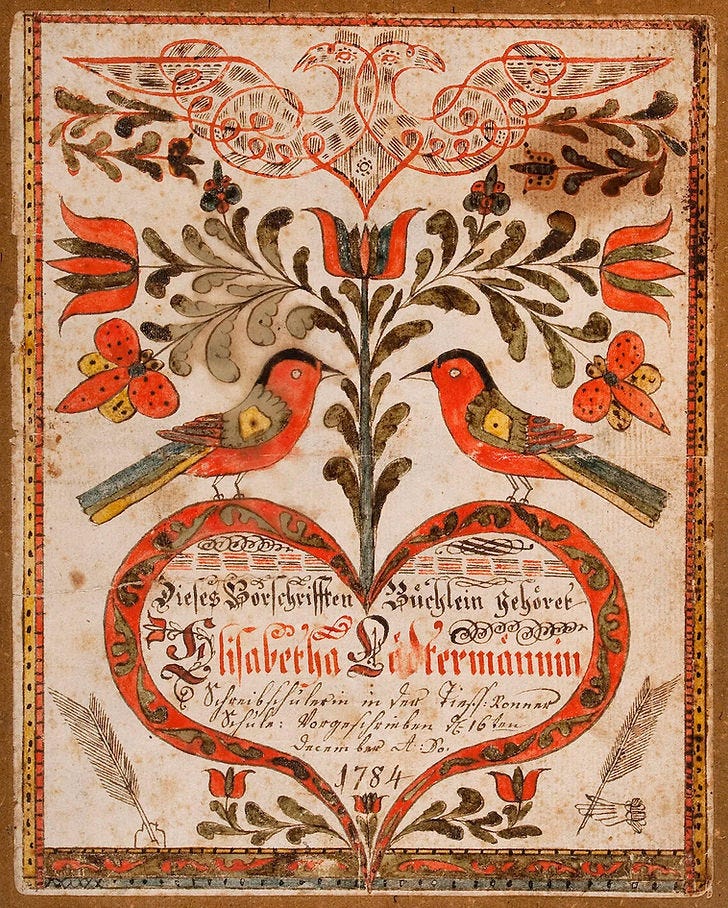
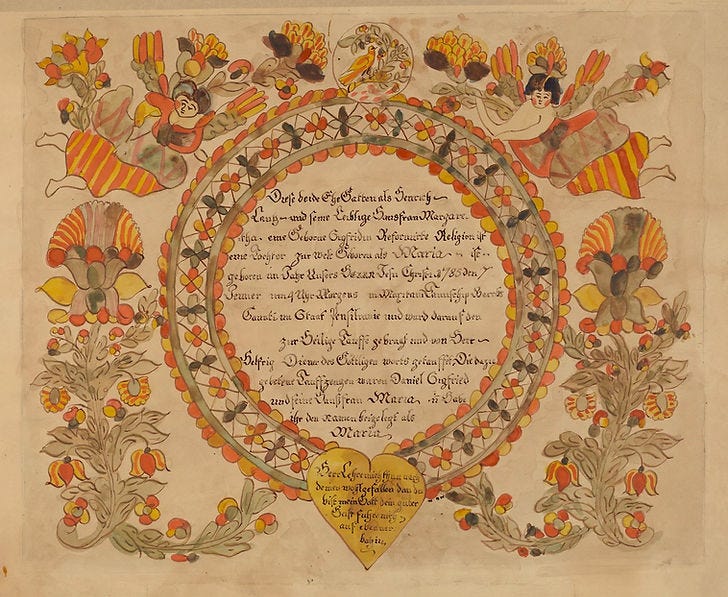
There was no local bureaucracy on the frontier, so these small farmers recorded births, marriages, and other events with hand-lettered, decorated documents, just as they had in the old country. Named fraktur for the medieval, “broken” style of lettering they used, these papers would be tucked into family Bibles, kept quietly for generations. They were honest and uncontrived, suffused with a joyful appreciation for everyday life. Filled with hearts, flowers, and animals, for their makers, fraktur were simply ordinary documents written in a language the Anglo neighbors couldn’t read—neighbors who dismissed them as German peasants, “dumb, hopeless, and beyond possible improvement.”1 They seemed un-American. Today, their fraktur are some of the most celebrated American folk art.
Links:
Fraktur Folk Art – Sasha Archibald, The Public Domain Review, n.d.
Drawn with Spirit exhibition at the Philadelphia Museum of Art (2015)
Too many emails? Instructions for receiving a weekly summary can be found here.
This post is part of The American 250, a series featuring 250 words on 250 objects made by Americans, located in America, in honor of the country’s 250th anniversary. Through December 31, 2026.
I’m looking for ideas for this series — have something you’d like me to consider for inclusion? Please feel free to leave a comment!
“What more fertile ground could there have been than this island of German peasant culture in the new world which, because it was composed of a different language group, was simply dismissed by the surrounding English and Scotch Irish settlers, as dumb, hopeless, and beyond possible improvement?”
Donald A. Shelley, The Fraktur-Writings or Illuminated Manuscripts of the Pennsylvania Germans (Allentown, PA: Pennsylvania German Folklore Society, 1961).
My sister-in-law's parents were born around 1915 and grew up in the Fredericksburg, Texas area. Both parents grew up in homes where German was spoken. I remember her mother saying she did not think speaking German in the home was unusual at the time but seemed to have stopped by her generation. I believe a German-language newspaper the Frederiksburg Wocheblatt circulated well into the early 20th century. From her mother I understood, schools in Gillispie County often taught German as a primary language along with English until sometime around the time of WW I.and by WW II there was suspicion or stigma attached to speaking German, so she and her husband never taught their children German. However, at my age I have learned that all memories are not factually true. If you are not already considering you may want to think about the Texas Painted Churches as a topic for the 250?
These are beautiful! I enjoy reading every one of these American 250’s.